
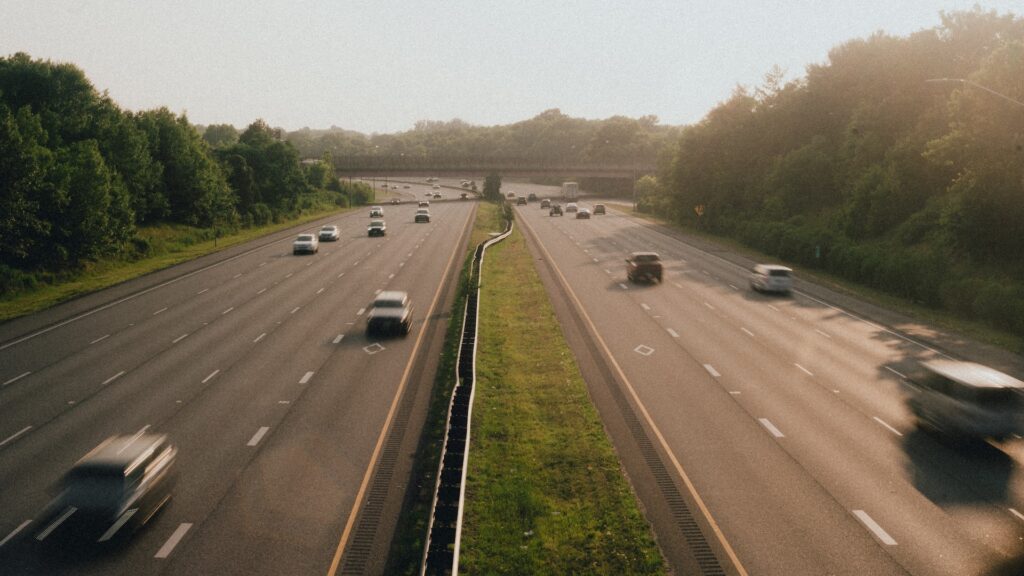
October Is National Slow Down Move Over Month
Every October, the towing and recovery industry pauses to recognize something that should never need reminding: the people helping you on the side of the road are in real danger every time they step out of their truck. October is National Slow Down Move Over Month, a campaign observed across all 50 states to raise awareness of Move Over laws and the men and women who depend on drivers following them.
At Marietta Wrecker, we have been responding to roadside calls across Marietta, Cobb County, and Metro Atlanta since 1974. Over 50 years of service means over 50 years of our drivers working inches from traffic on I-75, I-575, US-41, and Barrett Parkway. We take this month seriously because we live this reality every single day.
This post is our contribution to that conversation. Here is what Georgia’s Move Over Law actually requires, why it matters, and what you can do the next time you see flashing lights ahead on the road.
What Georgia’s Move Over Law Requires
The Law: O.C.G.A. 40-6-16
Georgia’s Move Over Law is codified under O.C.G.A. 40-6-16, also known as the Spencer Pass Law. It applies any time you are approaching a stopped vehicle displaying flashing lights in red, blue, white, yellow, or amber on a road with two or more lanes. The law covers law enforcement, fire and rescue, ambulances, utility vehicles, maintenance vehicles, and tow trucks and recovery vehicles.
When you see those lights, the law requires one of two things. If you can safely change lanes away from the stopped vehicle, you must do it. If changing lanes is not possible because of traffic or road conditions, you must slow below the posted speed limit to a speed that is reasonable for the conditions and be prepared to stop.
That is it. Move over, or slow down. The law is simple. Remembering it in the moment is the part that saves lives.
Which Vehicles Are Covered
A lot of drivers know to move over for police cruisers and fire trucks. Fewer realize the same law applies to tow trucks and recovery vehicles with their amber lights flashing. Every time a Marietta Wrecker driver pulls up behind a disabled vehicle on the side of I-75 or works a recovery scene on I-575, they are protected by this law. The obligation falls on every driver who passes that scene, without exception.
The law also covers stopped utility and maintenance vehicles displaying amber or yellow lights. If you are driving through Marietta or anywhere in Cobb County and see any vehicle stopped on the shoulder with lights flashing, the Move Over Law applies.
What Happens If You Do Not Move Over
The Penalties Under Georgia Law
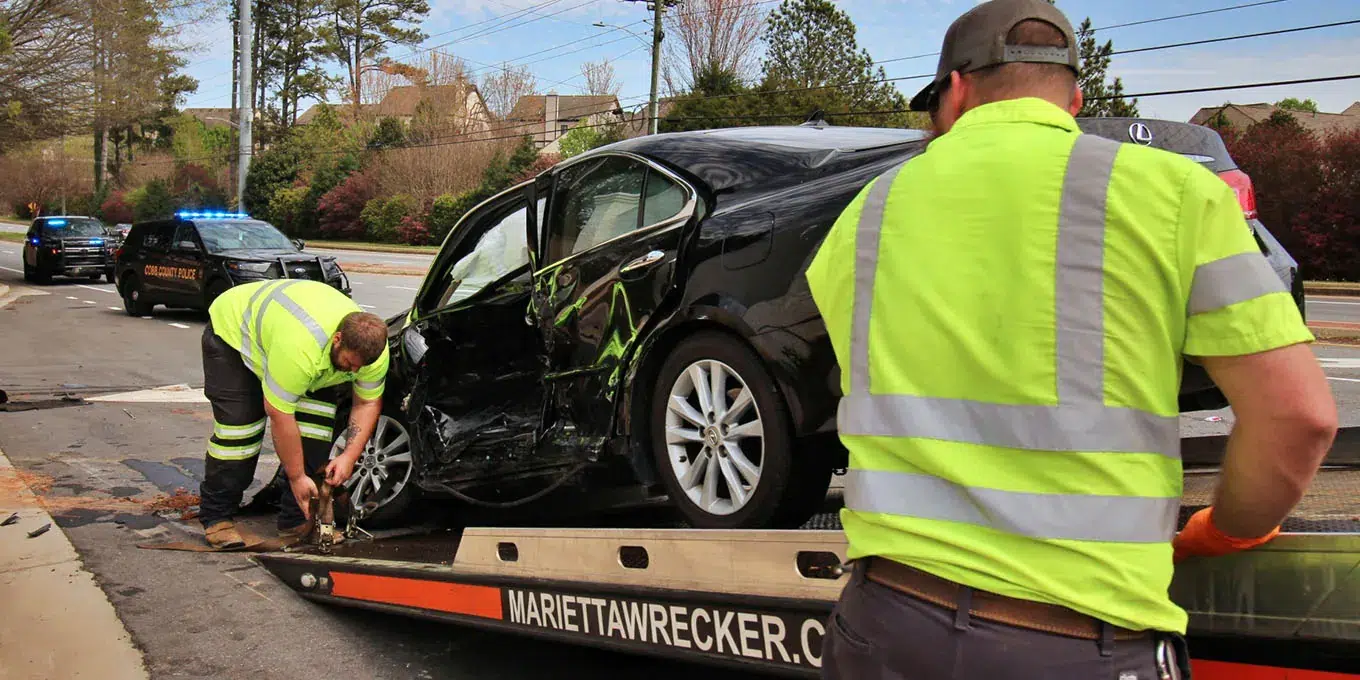
Failing to move over or slow down when passing a stopped emergency or roadside vehicle is a traffic infraction under Georgia law. A conviction carries a fine of up to $500. That is the baseline. If the violation results in an accident that injures or kills someone, the consequences escalate significantly. The driver can face criminal charges, potential jail time, loss of driving privileges, and civil liability that includes medical costs, pain and suffering, and vehicle damages.
The financial and legal exposure from a Move Over violation is real. More importantly, the human cost of a violation is irreversible.
Why the Risk Is So High
Tow truck operators work in one of the most dangerous occupations in the country. They respond at all hours, in all weather conditions, to scenes on high-speed roads where drivers are distracted, impaired, or simply not paying attention. The roadside is not a controlled environment. A single inattentive driver can change everything.
Our drivers on I-75 and I-575 work with traffic coming at them at highway speeds. They know the risk. They accept it because it is part of the job. What they need, and what the law requires, is for drivers to make that risk as small as possible by doing one simple thing: moving over.
What To Do When You See Flashing Lights Ahead
The sequence is simple and worth committing to memory.
Look ahead and identify the situation early. Flashing lights on the shoulder mean someone is working or waiting for help. Do not wait until you are close to react. Scanning ahead gives you the time and space to respond safely.
Check your mirrors and signal before changing lanes. A sudden lane change can create a new hazard if another driver is already moving into that space. Check your blind spot, signal your intention, and move over when it is clear to do so.
If you cannot change lanes, ease off the gas. Slow below the posted speed limit and hold that slower speed until you have fully passed the scene. Do not accelerate back to highway speed until the flashing lights are well behind you.
Put the phone down. Distracted driving is one of the leading causes of roadside fatalities. If you have your phone in your hand, you are not scanning the road ahead. A quick glance down at the wrong moment is all it takes.

How Marietta Wrecker Protects Its Drivers on Every Call
Our commitment to safety runs in both directions. We ask drivers on Cobb County roads to follow the Move Over Law, and we hold ourselves to the same standard of preparation and care on every call we run.
Every Marietta Wrecker operator goes out trained and equipped for roadside conditions. Our full fleet is outfitted with proper lighting to maximize visibility at any hour. Our drivers are trained in scene setup and safe positioning to minimize their exposure while working. We follow protocols designed to protect not just our crew, but the drivers and passengers we are helping.
When you call us for a tow or emergency roadside service in Marietta or anywhere in Cobb County, you can count on a team that takes its own safety as seriously as yours.
Spreading the Word in Cobb County and Metro Atlanta
National Slow Down Move Over Month is a reminder, but the work of keeping roadside workers safe happens 365 days a year. Here is how you can help beyond October.
Cobb County Roads Are Busier Than Ever
I-75 through Cobb County is one of the most heavily traveled corridors in Metro Atlanta. I-575 feeds commuter traffic from Cherokee County every morning and evening. US-41 and Barrett Parkway carry steady local volume through Marietta, Kennesaw, and Acworth all day long. That volume does not slow down when someone breaks down on the shoulder. It keeps moving, and that is exactly what makes every roadside call a high-stakes situation.
Marietta Wrecker responds to scenes on all of these roads, around the clock. The mix of highway traffic, commuter congestion, and unfamiliar drivers cutting through the area on I-75 means conditions shift constantly. Our drivers set up scenes in the dark, in the rain, and in merge zones where lane choices narrow and attention spans compress. They do it anyway, because someone needs help. The least any passing driver can do is give them a lane.
Make It Part of How You Drive in This Area
If you live or work in Marietta, Smyrna, Kennesaw, Acworth, or Powder Springs, you already know how fast conditions can change on these roads. A wreck on I-75 near the I-575 split backs traffic through Marietta in minutes. When that happens, tow operators are on scene managing live traffic. Moving over is not just a legal obligation in those moments. It is the difference between a scene that gets cleared safely and one that does not.
Share what you know with people in your life. A quick conversation with a teenage driver, a coworker who commutes on I-75, or a family member who uses Barrett Parkway daily can plant a habit that lasts. Most drivers who fail to move over are not malicious. They are inattentive or simply unaware of what the law requires.
Marietta Wrecker takes that responsibility seriously enough to act on it directly. Through our Automotive Safety Program, we offer a free, three-hour hands-on course for new drivers ages 14 to 19, taught in partnership with the Marietta Police and Fire Departments. The program covers changing a tire, jump-starting a car, vehicle safety inspections, and defensive driving. Getting young drivers comfortable with what to do when something goes wrong on the road is one of the most direct ways we know to make Cobb County roads safer for everyone, including the operators we put out there every day.
When you see a roadside scene and you do move over safely, you are doing exactly what this campaign asks. It takes about three seconds of attention and intention. For the person standing next to that truck on the shoulder of I-75, those three seconds mean everything.

Move Over Law in Georgia FAQ
What is Georgia’s Move Over Law?
Georgia’s Move Over Law, codified under O.C.G.A. 40-6-16, requires drivers on roads with two or more lanes to change lanes away from any stopped vehicle displaying flashing lights, including tow trucks, law enforcement, fire and rescue, and utility vehicles. If changing lanes is not possible, drivers must slow below the posted speed limit to a speed appropriate for the conditions.
Does Georgia’s Move Over Law apply to tow trucks?
Yes. Tow trucks and recovery vehicles are explicitly covered under O.C.G.A. 40-6-16. Any time a tow truck is stopped on the roadside with amber or other warning lights flashing, drivers are legally required to move over or slow down.
What is the fine for violating Georgia’s Move Over Law?
A basic Move Over Law violation in Georgia carries a fine of up to $500. If the violation results in a crash that injures or kills someone, the driver may face criminal charges, loss of driving privileges, and civil liability for damages including medical costs and pain and suffering.
What is the Spencer Pass Law?
The Spencer Pass Law is another name for Georgia’s Move Over Law, O.C.G.A. 40-6-16. The name honors a Georgia law enforcement officer killed in a roadside incident. It is the same law that requires drivers to move over or slow down for any stopped emergency or roadside service vehicle displaying flashing lights.
When is National Slow Down Move Over Month?
October is National Slow Down Move Over Month, observed across all 50 states. The campaign is supported by towing associations, law enforcement agencies, and roadside safety advocates to raise awareness of Move Over laws and honor roadside workers who have been injured or killed on the job.
What should I do if I cannot safely change lanes when passing a tow truck on the highway?
If traffic or road conditions prevent you from safely changing lanes, Georgia law requires you to slow below the posted speed limit to a speed that is reasonable and appropriate for the conditions, and be prepared to stop. The key is to reduce speed significantly before you reach the stopped vehicle, not after you are already passing it.

Slow Down, Move Over, Save Lives
Marietta Wrecker has served Marietta, Cobb County, and Metro Atlanta since 1974. The drivers who run our calls on I-75 and I-575 are part of this community. They are neighbors, parents, and longtime members of the same roads you drive every day. Every time they pull up to a scene, they are trusting that drivers behind them will do the right thing.
Georgia’s Move Over Law exists because that trust needs to be backed by law. October is the time to talk about it, share it, and recommit to it. But the habit of moving over does not have an off-season.